Retaining Walls Built for Colorado's Terrain
Colorado Springs sits along the Front Range where the Great Plains meet the Rocky Mountains. That transition creates the sloped, uneven terrain that makes retaining walls one of the most common landscaping needs in El Paso County. Whether you need to level a yard, prevent hillside erosion, create usable terraces, or protect a foundation from soil pressure, a properly engineered retaining wall is the solution.
CN Landscaping installs retaining walls throughout Colorado Springs, Monument, Falcon, Black Forest, Larkspur, and Perry Park. We build with segmental concrete block, natural stone, and timber — each material matched to the structural demands, aesthetic goals, and budget of your specific project.
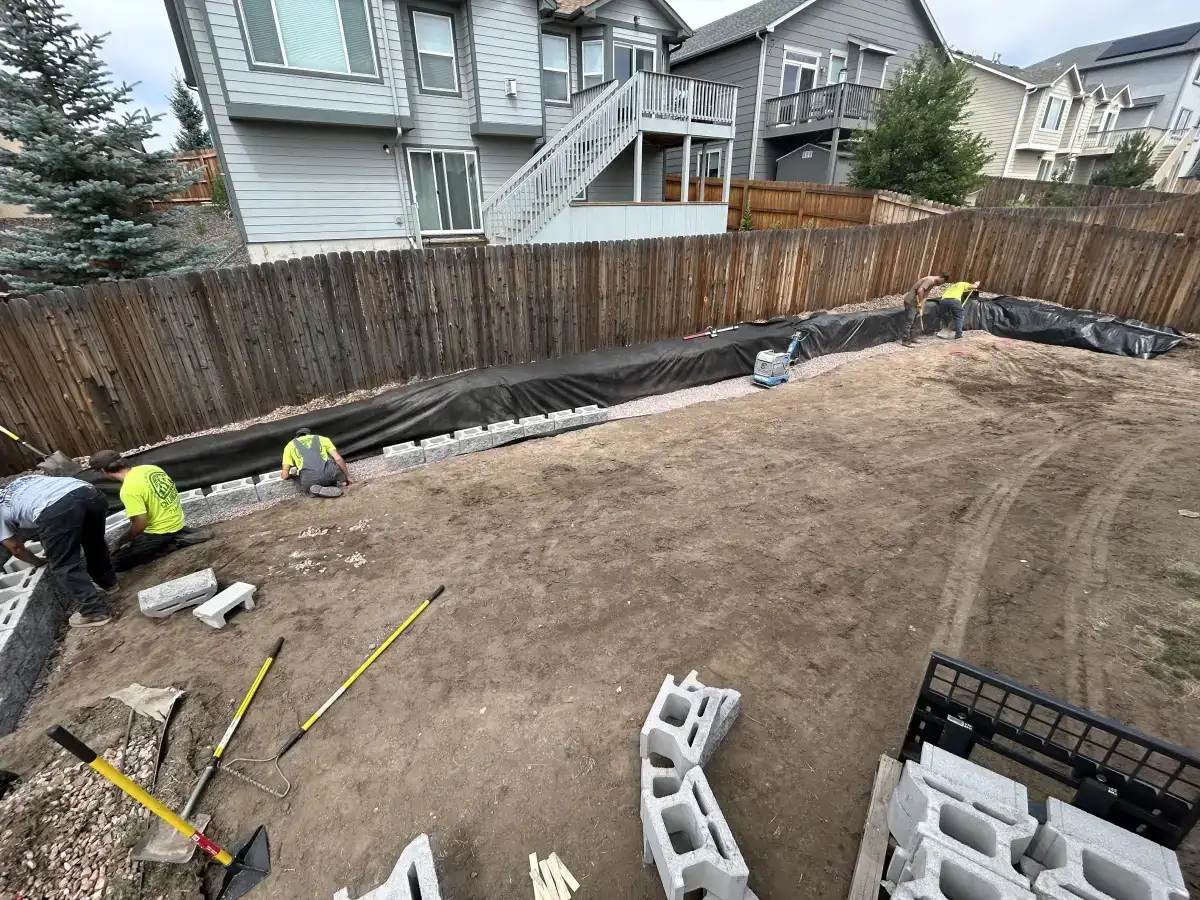
Every wall we build addresses the two factors that cause most retaining wall failures in Colorado: drainage and frost depth. Our walls include gravel backfill, filter fabric, perforated drain pipe, and footings set below the local frost line (typically 36 inches in the Colorado Springs area). This combination prevents the hydrostatic pressure buildup and frost heave that topple poorly built walls within a few years.
Types of Retaining Walls We Build
Each material serves different structural and aesthetic purposes. Here is how they compare for Colorado Springs conditions.
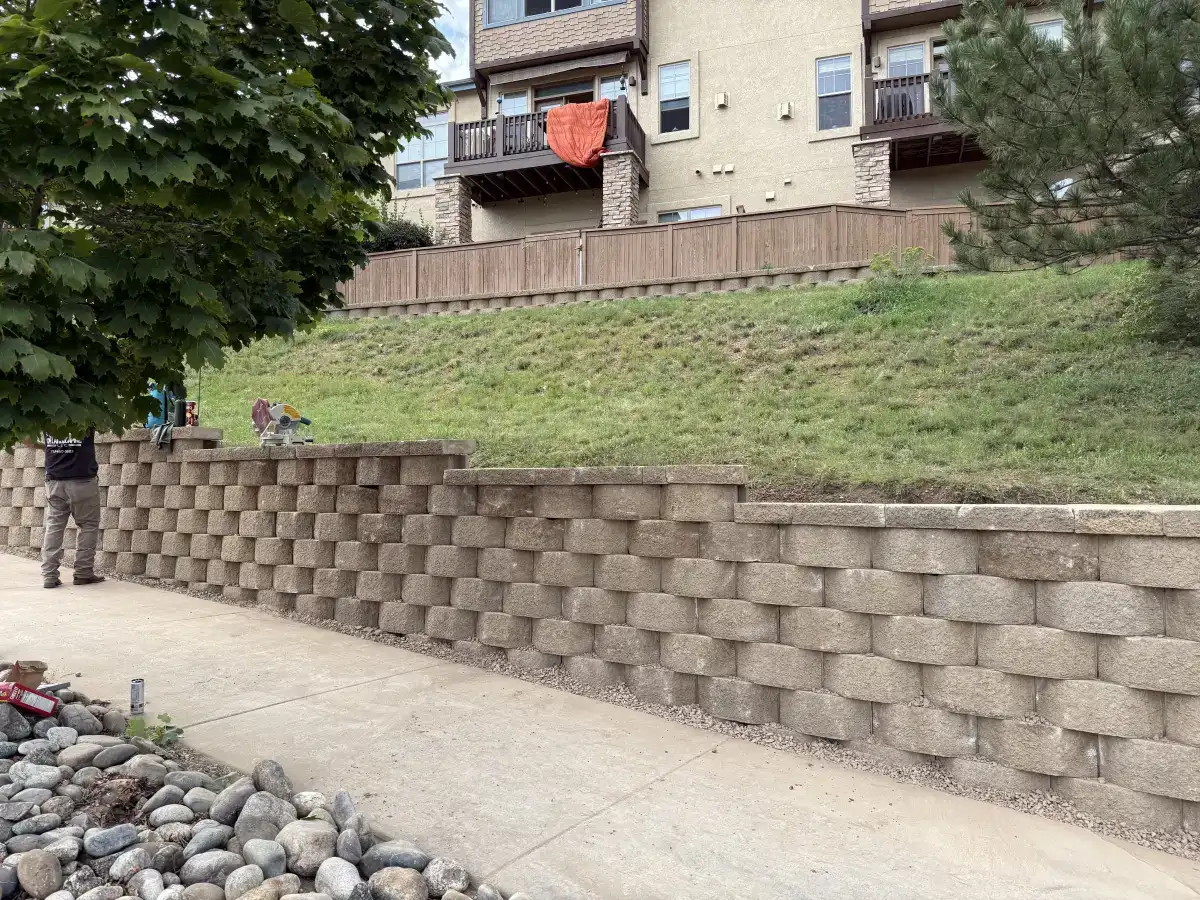
Segmental Concrete Block
Interlocking concrete block walls are the most popular retaining wall choice in Colorado Springs. The units stack without mortar, allowing the wall to flex slightly with freeze-thaw movement instead of cracking. Available in multiple colors and textures that mimic natural stone. Engineered systems like Allan Block or Versa-Lok can build walls up to 6 feet without additional geogrid reinforcement, and taller with engineering. Lifespan: 50 to 75 years. Average cost: $25 to $35 per square face foot installed.
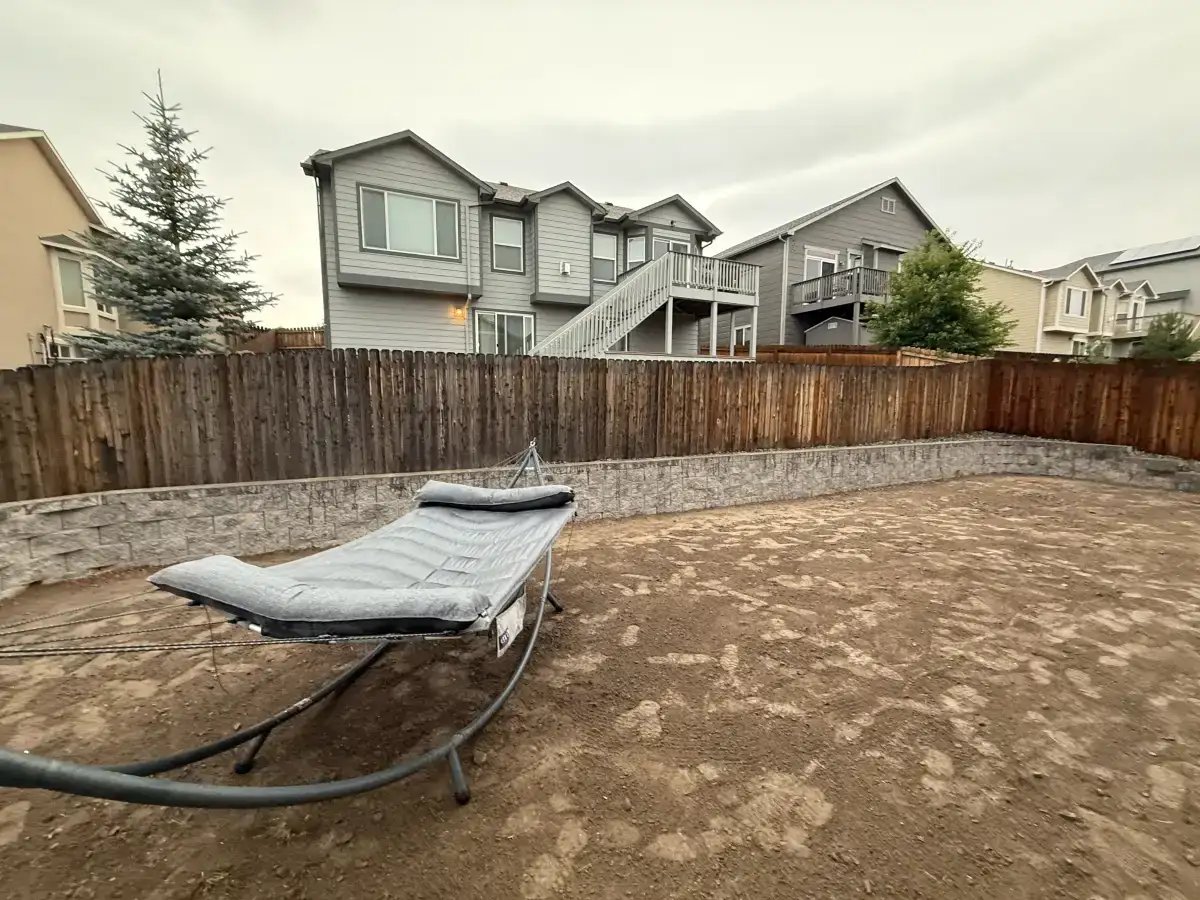
Natural Stone
Natural stone retaining walls deliver a premium look that blends seamlessly with Colorado's rocky landscape. We use Colorado moss rock, flagstone, and other locally sourced stone. Dry-stacked (no mortar) stone walls work well for walls under 3 feet and provide natural drainage through the face. Mortared stone walls offer more structural capacity for taller applications. Natural stone walls are labor-intensive to build, which increases cost, but the visual impact and longevity are unmatched. Lifespan: 75 to 100+ years. Average cost: $35 to $50 per square face foot installed.
Timber
Pressure-treated timber retaining walls are the most affordable option for shorter walls and garden terraces. Best suited for walls under 3 feet where structural loads are minimal. Timber walls integrate well with rustic and natural landscape designs. The trade-off is lifespan — even pressure-treated timber deteriorates in 15 to 20 years in Colorado's UV-intense, freeze-thaw environment. We use 6x6 or 8x8 timbers with deadman anchors and drainage behind the wall. Average cost: $20 to $30 per square face foot installed.
Understanding the Difference — and Why It Matters
Not all retaining walls serve the same purpose, and the distinction between structural and decorative walls affects design, materials, engineering requirements, and cost.
Structural retaining walls hold back soil that would otherwise slide, erode, or put pressure on foundations. These walls bear significant lateral load and must be engineered to resist soil pressure, water pressure, and surcharge loads (driveways, structures, or equipment above the wall). Walls over 4 feet in Colorado Springs require stamped engineering plans and a building permit.
Decorative retaining walls create garden terraces, raised planters, seating walls, and visual interest. While they still retain some soil, the loads are typically lower — often under 2 feet of retained height. These walls do not usually require permits or engineering, but they still need proper drainage and base preparation to last in Colorado's climate.
Many projects include both types. A common Colorado Springs design uses a structural wall to level a sloped backyard, then adds decorative terrace walls and seating walls above it to create usable outdoor living areas. CN Landscaping evaluates every project to determine the right approach and coordinates with structural engineers when required.
Why Retaining Walls Fail in El Paso County — and How We Prevent It
El Paso County's geology creates specific challenges for retaining wall construction that contractors from other regions often underestimate. Here is what we engineer for on every project.
Expansive clay soils: The clay soils throughout Colorado Springs swell up to 10% when wet and shrink when dry. This expansion pushes against retaining walls with tremendous force. We use a minimum 12-inch gravel backfill zone with filter fabric to prevent clay from migrating into the drainage layer. The gravel provides a stable, non-expansive buffer between the wall and native soil.
36-inch frost depth: The frost line in Colorado Springs is approximately 36 inches. Retaining wall footings must extend below this depth to prevent frost heave from lifting and tilting the wall. Shallow footings are the number one cause of wall failure in our area.
Steep terrain and drainage: Many properties sit on slopes of 15% to 30% grade or steeper. Surface water and subsurface water must be managed behind every wall. Our standard drainage system includes 4-inch perforated pipe at the base, wrapped in filter fabric, bedded in clean gravel, and daylighted to a safe discharge point.
Wildfire and defensible space: In areas like Black Forest and the foothills, retaining walls play a role in creating defensible space around homes. Non-combustible materials (block and stone, not timber) are preferred in high fire-risk zones.
Retaining Wall Costs in Colorado Springs
Transparent pricing based on wall material, height, length, and site conditions. Every estimate is detailed and itemized.
Typical Cost Ranges
Segmental block: $25 to $35 per square face foot installed. A 50-foot-long wall at 3 feet tall (150 sq ft) costs approximately $3,750 to $5,250.
Natural stone: $35 to $50 per square face foot installed. The same 150-square-foot wall costs $5,250 to $7,500.
Timber: $20 to $30 per square face foot installed. That same wall runs $3,000 to $4,500.
Additional Cost Factors
Engineering plans: Walls over 4 feet require stamped plans from a licensed PE, typically $1,500 to $3,000.
Geogrid reinforcement: Taller walls need geogrid layers, adding $3 to $8 per square face foot.
Access difficulty: Properties with limited equipment access (steep driveways, narrow side yards) may increase labor costs by 10% to 20%.
Demolition: Removing an existing failed wall adds $5 to $15 per square face foot for demo and hauling.
Retaining Wall FAQs
Retaining walls in Colorado Springs typically cost $25 to $50 per square face foot installed, depending on material and wall height. Segmental concrete block averages $25 to $35, natural stone runs $35 to $50, and timber walls cost $20 to $30 per square face foot. A 50-linear-foot wall at 3 feet tall (150 square face feet) runs $3,750 to $7,500. Walls over 4 feet require engineering plans, which add $1,500 to $3,000 to the total project cost.
In Colorado Springs, retaining walls over 4 feet in height (measured from the bottom of the footing to the top of the wall) require a building permit from the Pikes Peak Regional Building Department. Walls over 4 feet also require stamped engineering plans from a licensed Professional Engineer. Walls under 4 feet generally do not require permits unless they support a surcharge load like a driveway or structure. CN Landscaping handles all permitting and engineering coordination.
Segmental concrete block walls are the most popular choice in Colorado Springs because they handle freeze-thaw cycles well, require no mortar joints that can crack, and install efficiently on sloped lots. Natural stone walls offer a premium aesthetic that blends with Colorado's terrain. Timber walls are the most affordable but have a shorter lifespan of 15 to 20 years compared to 50+ years for block and stone. The best choice depends on wall height, structural requirements, and your design preferences.
A properly built segmental block or natural stone retaining wall lasts 50 to 100 years in Colorado. Timber walls last 15 to 20 years before needing replacement. The key factors for longevity at altitude are proper drainage behind the wall, adequate base preparation below frost line, and correct batter (lean-back angle). Walls that fail prematurely almost always have drainage problems — water builds up behind the wall, freezes, expands, and pushes the wall forward.
Yes. Retaining walls are one of the most effective tools for managing water runoff and erosion on Colorado properties. By terracing a slope, you reduce the speed and volume of surface water flow. Combined with proper drainage behind the wall (gravel backfill, filter fabric, and perforated drain pipe), retaining walls redirect water away from foundations and prevent erosion. Many Colorado Springs homeowners install retaining walls specifically to solve water management issues caused by the region's clay soils and steep lots.
Need a Retaining Wall in Colorado Springs?
Get a free, no-obligation estimate for your retaining wall project. Serving Colorado Springs, Monument, Fountain, Falcon, Black Forest, Larkspur, and Perry Park.